
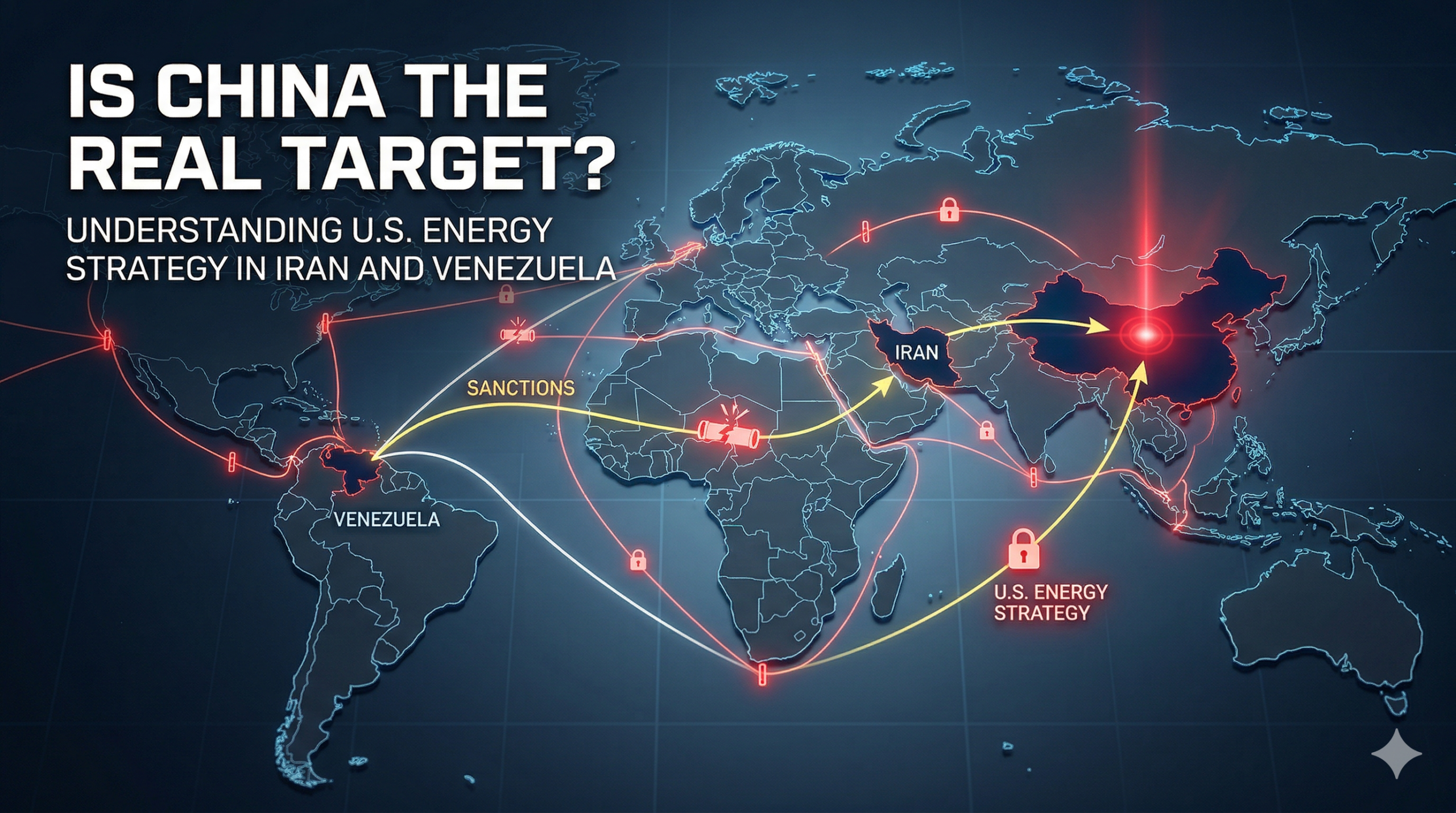
In the theater of global geopolitics, oil has always been more than a commodity; it is the lifeblood of national power. For decades, U.S. sanctions on Iran and Venezuela were viewed through the lens of regional stability, counter-proliferation, and human rights. However, as the 2020s progress, a more complex narrative is emerging among strategic analysts.
There is a growing consensus that the “primary” targets of these sanctions—Tehran and Caracas—may actually be secondary to a much larger objective: limiting China’s access to the discounted energy it needs to fuel its rise. By examining the US energy strategy China faces today, we can see a sophisticated “energy encirclement” that mirrors historical maneuvers and reshapes global oil geopolitics.
The “Teapot” Connection: China’s Backdoor to Discounted Oil
To understand why China is central to this strategy, one must look at its “teapot” refineries—the small, independent refiners primarily located in Shandong province. Unlike China’s state-owned giants (like Sinopec), these teapots are highly risk-tolerant and operate on razor-thin margins.
- The Discount Factor: In 2025, sanctioned crude from Iran and Venezuela accounted for approximately 17–18% of China’s total oil imports. Because this oil is “radioactive” to Western buyers, it is sold at steep discounts—often $10 to $15 below Brent crude.
- Economic Advantage: This cheap feedstock gives China a massive competitive edge in manufacturing and exports, effectively acting as a multi-billion dollar subsidy for the Chinese economy.
- Shadow Logistics: To bypass Iran oil sanctions, China has mastered “shadow” logistics. Tankers frequently run “dark” (turning off transponders) and engage in ship-to-ship transfers in the South China Sea, where Iranian or Venezuelan oil is relabeled as Malaysian, Omani, or Indonesian.
By tightening the screws on these specific flows, the U.S. isn’t just punishing “rogue states”; it is attempting to raise the input costs of the entire Chinese industrial machine.
Strategic Encirclement: From the Caribbean to the Persian Gulf
The Venezuela oil exports China relies on have recently become a focal point of U.S. pressure. Under recent shifts in policy, the U.S. has moved to redirect Venezuelan exports through approved trading firms or towards Western markets.
The Impact on China’s Energy Security
When the U.S. restricts Venezuelan and Iranian output, it forces China to compete for “transparent” barrels from the Middle East or West Africa. This has two immediate effects:
- Increased Costs: China loses its “sanction discount,” forcing it to pay market rates.
- Strategic Vulnerability: It pushes China further into the Strait of Hormuz and the Malacca Strait—maritime chokepoints where the U.S. Navy maintains significant influence.
The Russia-Ukraine Variable
The war in Ukraine added a third pillar to this energy triad. While Russia remains a top exporter, the G7 price caps and shifting trade routes have forced Moscow to pivot toward Asia. However, the U.S. and its allies have used this shift to monitor and regulate the price at which China buys Russian oil. By 2026, the global energy landscape has become a bifurcated system: a Western-led transparent market and a “shadow market” that the U.S. is systematically trying to dismantle.
Historical Echoes: The 1930s Japan Comparison
The current U.S. strategy against China bears a striking resemblance to the oil embargoes used against Imperial Japan in the late 1930s.
Historical Context: In 1940-1941, the United States used its position as a primary oil supplier and its influence over global shipping to cut off Japan’s energy lifelines. The goal was to halt Japan’s military expansion in China without engaging in direct combat.
The modern parallel is clear. While the U.S. and China are not at war, the U.S. is using its “energy superpower” status—fueled by its own domestic shale revolution—to manipulate the global supply chain. By keeping Iranian and Venezuelan oil “offline” or difficult to access, the U.S. limits the energy surplus available to its primary systemic rival.
Counterarguments: Is it Really About China?
Not all analysts agree that China is the “real” target. Critics of this theory argue that U.S. policy is driven by simpler, more traditional motives:
- Nuclear Non-Proliferation: Sanctions on Iran are primarily a response to its nuclear program, a concern that predates the current U.S.-China rivalry.
- Regional Hegemony: In Venezuela, the U.S. objective is to maintain influence in its “near abroad” and counter anti-American regimes in the Western Hemisphere.
- Domestic Politics: U.S. energy policy is often dictated by domestic lobbying from the oil and gas sector, which benefits from the higher prices and market share that come when competitors like Iran are sidelined.
However, even if China wasn’t the original target, it has certainly become the strategic target. Every barrel of oil the U.S. keeps out of China’s hands is a win for American “Integrated Deterrence.”
Conclusion: The New Energy Cold War
The U.S. energy strategy toward Iran and Venezuela is no longer just about regional regime change. It is a vital component of a broader competition with Beijing. By targeting the “shadow” oil trade, the U.S. is attempting to force China out of the gray market and into a global energy system where the rules—and the prices—are set by the West.
As we move toward the late 2020s, the battle for energy security will likely shift from the volume of barrels to the cost of barrels. If the U.S. can successfully eliminate the “sanction discount,” it will have landed a significant blow against China’s economic momentum without ever firing a shot.
Given the rising cost of energy and the shift toward “shadow markets,” can China truly achieve energy independence, or is it destined to remain vulnerable to U.S. maritime and financial leverage?